The Literature is related to Revealing the Powerful Impact of Tesco’s Revolutionary Sustainability Initiatives on Unwavering Customer Retention and Loyalty in the U.K
Tesco, one of the largest retailers in Great Britain, has introduced numerous environmental policies that define the company’s commitment to address current social problems and minimize negative environmental impacts. Knowledge about customers’ attitudes towards Tesco’s sustainability activities can easily explain the effects on customers’ loyalty. It is, therefore, imperative to establish the correlation between customers’ perception of Tesco’s sustainability initiatives and their level of commitment towards the brand in line with the evaluation of the effectiveness of such initiatives.
In this section of the literature review, these initiatives will be explained according to the current literature and official reports regarding the scope and aims of the initiatives. The following literature and studies section also summarizes current research done publicly to understand how Tesco’s sustainability initiatives are perceived in the U.K. Further, Based on the literature and previous research findings, this section discusses how positive attitude towards sustainability initiatives impacts Tesco’s customer loyalty (Filimonau & Gherbin, 2017).
Thus, evaluating Tesco’s sustainability endeavors regarding customer loyalty in the U.K. market is crucial for analyzing these measures’ efficacy. This section of research aims to shed light on how Tesco’s sustainability policies affect its customer loyalty by conducting a literature and study analysis.
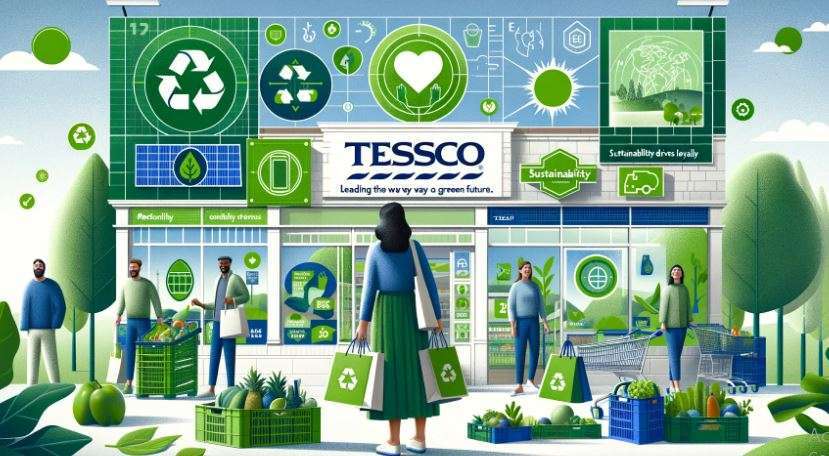
2.2 Specific Sustainability Initiatives Has Tesco Implemented in the U.K.
Reducing Carbon Emissions
Tesco, for instance, has a long-term emission reduction goal of reaching a zero-carbon business by the year 2050 and a short-term goal of achieving a 60% cut in emissions by the year 2025 relative to the year 2015 (Tidy et al., 2016). The company has expanded the use of renewable power, enhanced energy efficiency impacting stores and distribution facilities, and assumed and decreased the usage of sustainable EFV vehicles. A report by the Carbon Trust (2020) reveals that Tesco has integrated solar panels at several stores and distributing centers and also has been buying R.E.C.s to cover its carbon impact (MacDonald, 2005)
Waste Reduction and Recycling
The last one of the underpinning operational models for Tesco includes tackling and managing food waste. Tesco elaborated that it wants to eliminate half of the wasted food in its operations by 2025, adopting the FareShare model as the company cooperates with it to redistribute surplus food. Moreover, there has recently been a focus on streamlining packaging waste by urging suppliers to cooperate with the ‘Recycle at Tesco’ project, which enables customers to bring plastic packaging back to the Tesco store for recycling. As per Norton & Flynn, 2021, Tesco has also been at the forefront of the U.K. Plastics Pact, whose vision is to get rid of the difficult-to-manage plastics and also to make all the plastics used for the packaging to be either recyclable, reusable, or compostable by the year 2025 (Norton & Flynn, 2021)
Sustainable Sourcing
Some of the sustainability actions that Tesco has taken for the foods it sells are as follows: It has made a pro-attempt to use certified sustainable palm oil, timber, and soy by sourcing from sustainable sources. Tesco’s sustainable seafood policy ensures that all wild-capture fish they sell within their stores are either M.S.C. certified or part of a T-FIP. Tesco P.L.C. Annual Report (2022) also reveals that the company has also been engaging farmers in sustainable agriculture that reduces pesticide use and soil health (Chen, 2022).
Supporting Local Communities
Thus, over and above the environmental campaigns, Tesco achieves sustainable social responsibility. Some corporate social responsibilities include donating to local causes through the Kentucky firm’s “Bags of Help,” where money from selling plastic carriers is used to support various projects. Also, it is necessary to mention that Tesco has participated in many charitable actions, such as granting money to local schools and food banks. According to Imrie & Dolton, some of these moves have been useful in building goodwill with local communities and improving Tesco firm’s C.S.R. (Imrie & Dolton, 2014).
Promoting Health and Wellbeing
Tesco has also adopted measures to ensure healthy living standards in the company as well as among the company’s consumers. The company’s “Little Helps Plan” has initiatives and pledges concerning better health through accessible and affordable foods. Today, Tesco has worked out several easy-claiming strategies on the issue of several of its own-brand products with low sugar, salt, and fat content, plus improved nutritional information that would allow its customers to make more informed decisions. A study by the British Nutrition Foundation found that Tesco has taken measures that meet the customers’ approval, hence the company’s impressive image (Gibson‐Moore & Spiro, 2021).
Tesco’s Customers Perceive the Company’s Sustainability Initiatives
People’s Perception of Sustainability Initiatives
Surveys suggest that Tesco’s sustainability schemes on the whole are acceptable to customers; customers expect much more C.S.R. When it comes to perception, John’s survey reveals that a large number of Tesco’s customers have some level of awareness about the company’s sustainability programs, and most of them have a positive impression about them. A range of commitments are the focal points of the customers’ satisfaction: carbon footprint reduction, waste limitation, and efficient sourcing (Jones et al., 2009)
Environmental Initiatives
Besides viable strategies, customers value environmental activities such as carbon emission and waste control through Tesco. Studying the topic, Tesco’s attempts at reducing minimal food waste and recycling age are positively perceived by eco-aware customers. Customers tend to view Tesco as a highly sustainable company, especially in matters concerning the elimination of plastic waste and the use of recyclable items. Another aspect pointed out by Sirieix is that customers understand the company’s investment and want to see it carry on with funding the sourcing of renewable energy and the efficient running of stores (Sirieix et al., 2012).
Sustainable Sourcing
This is mainly because the customers positively associate Tesco with sourcing its raw materials in a sustainable manner and its aim to attain sourcing of 100% sustainable palm oil, timber, and soy. Customers also rely on Tesco’s chain when buying fish and seafood because the firm supports sustainability measurements that more consumers demand today. According to Wright, studies state that another factor that contributes to increasing a positive attitude toward Tesco is the company’s activity in informing the public about its experience in sustainable sourcing practices and the results achieved (Wright, 2015).
Community Say and Social Responsiveness
Customers are equally receptive to other social responsibility programs by Tesco, such as the ones that touch on the support of local communities. According to Hillary Shaw, customers approve of the “Bags of Help” and other community support programs, which improve Tesco’s corporate image in the eyes of the customers. Local community involvement and charitable organizations also positively affect customer loyalty; therefore, retaining them is more accessible (Shaw, 2006).
Health and Wellbeing Initiatives
Everything that Tesco does to encourage its customers’ and employees’ health and well-being is well-received. Hammant’s interview revealed that customers appreciate Tesco’s efforts to make healthy foods available and within people’s reach. The straightforward display of nutritional information on its products and changes aimed at lowering the concentrations of sugar, salt, and fat present in its products are viewed as authentic initiatives aimed at assisting the customer’s wellbeing, thus contributing to the improvement of Tesco’s image as a caring grocery store (Lee & Hammant, 2022)
Customer Loyalty and Retention
Therefore, a clear relationship exists between Tesco’s customers’ perception of its sustainability practices and their loyalty to the company. Azan and Karima found that enhancing customer awareness of Tesco’s sustainability programs increases customer loyalty and brand endorsement. The research also revealed that sustainability activities lead to a higher degree of customer affective commitment, which is a dominant factor in customer loyalty to the Tesco group (Azan & Karimah, 2022).
Areas for Improvement
In general, Tesco’s initiatives for sustainability received quite a positive appreciation, though there are prospects for further improvements. There is still room for improvement regarding the limitation of plastic waste and sustainability reporting. Hassan (2012) provided a survey statingstating that customers are becoming more exigent about their expectations regarding additional information regarding Tesco’s changes, specifically within the framework of sustainability and enhanced implementation of the actions (Hassan, 2012).
Relationship between Customer Perceptions of Tesco’s Sustainability Initiatives and Their Loyalty to the Brand
Customer Perceptions and Brand Loyalty.
A literature review reveals that favorable customer perceptions of a firm’s sustainability initiatives are associated with customer loyalty. Some of the key highlights of the research were: According to Yowson and Tomoah, customers tend to be loyal to brands that they consider to be sustainable as far as the social and natural environment is concerned. This behavior is even more apparent among the young generation of consumption society, who are willing to pay for sustainably produced commodities (Yawson & Yamoah, 2022).
Impact of Environmental Initiatives
Customers are sensitive to environmental practices, implying that Tesco’s programs, such as cutting carbon emissions and encouraging recycling practices, affect customers’ loyalty to the organization. Carbon Trust supports the statement that consumers aware of Tesco’s attempts to minimize its environmental impact will likely have a favorable perception of the brand. This positive image manifests in consumers being willing to buy from firms with such characteristics rather than those that do not (Hornibrook et al., 2013).
Trust and Transparency
The presentation of social responsibility policies and any other actions and policies related to sustainability are fundamental for creating trust, which is a significant factor in customer loyalty. According to Gjelsvik and Ingrid Hansgård, Tesco has enjoyed good customer trust because of its detailed disclosure of its sustainability issues. This proves that when customers are assured of a company’s commitment to sustainability, they are likely to be loyal to the brand. The study also illustrated that better and more truthful communication about sustainability activities strengthens the brands’ psychological bond with their consumers (Gjelsvik, 2014).
Community Engagement/social responsibilities
Most promotional programs, including local community support projects like ‘Bags of Help,’ significantly increase customer loyalty at Tesco. Jones revealed that customers who believe that Tesco contributes to the welfare of communities will continue to shop with that brand. This increases customers’ loyalty due to community involvement and the feeling of contributing to society towards a better future (Jones et al., 2007).
Examining consumer behavior and brand preference.
Research evidence concerning consumers’ perceptions shows that perceived sustainability affects brand preference and loyalty. The research conducted by Utama in 2022 shows that consumers are willing to choose Tesco over competitors if they have a positive perception of Tesco’s sustainability strategies. This is due to the perception that the roles of its corporate values match those of the organization and, therefore, support Tesco’s position as a loyalty factor (Utama, 2022).
Challenges and Opportunities
Most studies show that sustainability perception positively affects customer loyalty, but some things could be improved. There may be some customers who may still be weary of some organizations green-washing their image. A report from Palmer in 2005 reveals that customers want assurance of sustainable measures, adding that the company may need to provide strong evidence of sustainability measures it has in place. This creates a good chance for Tesco to improve its communication and may offer more information concerning its sustainability performance (Palmer, 2005)
Tesco’s Sustainability Initiatives Impact Customer Retention in the UK Market
Sustainability Perception of Customers and Development
Existing research shows that enhanced customer awareness and favorable perception of enterprises’ sustainability activities are helpful in customer loyalty. The sustainability report from the Bilińska-Reformat in 2019 showed that people who are well-informed about Tesco’s initiatives for lowering carbon footprinting and encouraging recycling will continue to repeat business with Tesco. It also revealed that consumers appreciate those brands that reflect their own beliefs, whereas environment friendly is a compelling belief among many customers (Bilińska-Reformat et al., 2019).
Environmental initiatives and customer loyalty.
Measures like combating plastic bag use, championing reusable bags, and checking on environmentally friendly products are focal themes in Tesco’s sustainability plan. Azan and Karimah, in 2022, do state that Tesco’s efforts to reduce plastic usage and enhance the option of recyclable products and offers have been commendable and appreciated by the clients (Azan & Karimah, 2022). These measures contribute towards reinforcing the brand’s image and improving customer loyalty rates since consumers with an ecological conscience will only proceed to support any environmentally friendly organization.
Support the community and their level of social responsibility.
Some activities that benefit the community, such as Tesco’s “Bags of Help,” which supports local community projects, increase customer loyalty. In 201, Samy stated that due to Tesco’s obvious and concrete actions in customer communities, people feel closer to Tesco. This aspect of community engagement clarion call ensures customer loyalty that implies repeat business because people like to see their monies going to the support of their immediate community (Samy et al., 2010)
.
Health and Wellbeing Initiatives
Better health and wellbeing of Tesco’s customers—through factors such as choice and availability of healthy food, clear nutritional information, and successful implementation of the Nutritional Quality Charter—create customer loyalty at Tesco. According to Campell’s research, in 2018, customers valued Tesco’s assistance in providing healthier food options. Customers who see Tesco’s brand as a company concerned with their health status will continue patronizing it, thereby improving the retention rate (Campbell et al., 2018).
Sourcing of products and services, as well as the promotion of ethical conduct
Sustainable sourcing and the general fight against unfair business practices increase customer loyalty, such as Tesco’s sourcing of 100% sustainable palm oil and marine products. Another survey by Nygaard (2015) confirms that modern consumers are eager to know the consequences of their consumption and want to purchase from organizations that act responsibly. I also noticed that Tesco clearly communicates its activities to change towards sustainability, increasing people’s credibility and loyalty to the company (Nygaard et al., 2015).
Conclusion
Tesco’s sustainability processes in the U.K. are complex and cover nearly all aspects, including carbon management, waste management, sourcing of supplies, community support, and health promotion campaigns. The literature and reports reviewed concerning their implementation show that such initiatives are well-reported and accredited for their positive impacts. Through the continuation and expansion of more such schemes, the company seeks to improve its sustainability standing and boost customer loyalty.
By appreciating and analyzing the particular measures that Tesco has taken about sustainability, it is easier to consider their effects on customers’ loyalty. Tesco’s customers were largely positive regarding the company’s sustainability policies. Due to every person’s increased awareness of the importance of sustainability in the contemporary world, the perception of Tesco’s approach to sustainability, among other factors, plays a vital role in customer loyalty and retention. The literature expounded shows how customer impressions about Tesco’s sustainability activities affect their brand allegiance. Customer satisfaction and loyalty, especially with environmental and social policies and health-conscious issues, also strongly influence Tesco’s position. The study’s findings reveal a positive relationship between customers’ awareness of Tesco’s environmental, social, and health-related activities and purchase intentions. Subsequently, sustainability being a strategic priority for the company, Tesco’s rebuilding and frequent advertising of practices within the area can go a long way in establishing a more favorable rapport between the supermarket and its consumers owing to the currently wise clientele.